

 Processing

Gene Synthesis
This easy-to-use solution is for researchers who want to skip in-house cloning steps and move quickly into functional studies with 100% sequence-verified clonal DNA.
Ordering
Complete synthetic genes with 100% sequence verification come in a plasmid cloning vector and are ready to use for a variety of applications.
- Guaranteed delivery dates
- Easy online ordering and order tracking
- No minimum order required, or additional charges for custom vectors
Genes
Genes ≤5000 bp will be delivered dry in a circularized plasmid and normalized to 4 µg final yield.* For genes ˃5000 bp, please contact us.

Loading...
* Gene sequences with added complexity can interfere with assembly and/or sequencing performance. Such sequences may result in less synthesis yield and/or additional services charges.
1 The time required to manufacture a gene is dependent on length, complexity, and vector choice. >85% orders are ready to ship within the number of business days indicated. Sequences that are unstable and/or toxic to E. coli can substantially affect delivery times.
Custom Vector Onboarding NEW
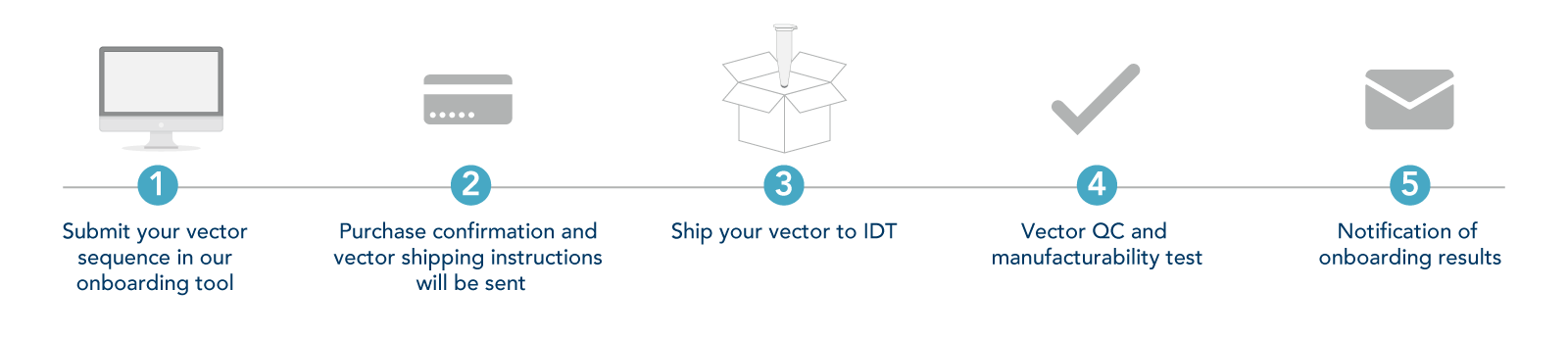
If your experiment requires a vector that isn’t available in our standard genes tool, no problem. You can easily onboard your own custom vector through our website without requesting a quote.
Advantages to onboarding your vector with IDT:
- Saves you time and we do the cloning for you. Once onboarded you can order cloned genes in your vector anytime
- Onboarding has a one-time cost, no recurring fees for additional inserts
- Fast turnaround times
- Confidentiality is a high priority to make sure your IP is safe
Loading...
IDT cloning vectors
All our gene synthesis products are provided in an optimized cloning vector that is ready to be transformed into E. coli. To optimize manufacturing and delivery times, genes ≤5 kb in length are delivered in a “best-fit” vector (Table 1), with a choice between ampicillin or kanamycin selection markers. We also offer vectors that have been optimized for use with Golden Gate Assembly; they will not have the most frequently used Type IIS restriction sites. Upon receiving your gene, you can then subclone it into the vector of your choice using a variety of methods. The identity of the cloning vector used, its sequence and insertion site will be confirmed in the documentation that accompanies your product.
Table 1. Best-fit vectors for Genes ≤5000 bp
| Vector name | Vector size | Selection marker | Application | Sequence |
|---|---|---|---|---|
| pUCIDT (Amp) | 2752 | Ampicillin | Cloning | pUCIDT (Amp).txt |
| pUCIDT (Amp) Golden Gate | 2752 | Ampicillin | Cloning | pUCIDT (Amp) Golden Gate.txt |
| pUCIDT (Kan) | 2705 | Kanamycin | Cloning | pUCIDT (Kan).txt |
| pUCIDT (Kan) Golden Gate | 2705 | Kanamycin | Cloning | pUCIDT (Kan) Golden Gate.txt |
| pIDTSmart (Amp) | 2056 | Ampicillin | Cloning | pIDTSmart (Amp).txt |
| pIDTSmart (Kan) | 1962 | Kanamycin | Cloning | pIDTSmart (Kan).txt |
For genes >5000 bp, please contact us.

Request a consultation
Have questions for our experts? Want to onboard your own vector? Your time is valuable and we’ll prioritize your inquiry. Click on “Request a consultation” to provide brief information about your project, and we’ll be in touch to discuss it ASAP.
Request a consultationProduct details
Genes and MiniGene™ Synthetic Genes are NGS-verified, circular double-stranded DNA in a plasmid. DNA sequences 25 bp to 5 kb are provided with IDT’s in-house cloning vectors, or a custom plasmid vector of your choice (see Table 1) without additional cloning fees. Sequences greater than 5 kb can be reviewed for acceptance as a custom project. Plasmids are delivered dry and ready-to use with an accompanying QC report.
Product data
Sequence verification
All inserts for Genes and MiniGene products are sequence-verified by NGS. Upon delivery of the plasmids, a NGS-sequencing report, plasmid map and FASTA file are all available to you in your online IDT account.
Resources


Flyers
Frequently asked questions
Will IDT store my vector?
We store onboarded custom vectors for two years after the most recent order in that vector, at no additional fee.
What if my vector does not meet the requirements above?
We are open to reviewing your vector if it does not meet the above criteria. Please contact your regional scientific applications support team with details of your vector, providing the
sequence in FASTA format, if possible.
Are the custom genes delivered as linear fragments or in a vector?
IDT Genes and Mini Gene™ sequences are delivered as double-stranded DNA, cloned into your provided custom vector.
What is required for the insertion site?
Please provide the 50 bases of sequence flanking the insertion site you wish us to use. IDTs proprietary assembly method requires no restriction sites and can remove existing sequences from a vector.
What type of plasmid prep is required for my custom vector?
Simple plasmid preps using a spin column or alkaline lysis method of purification are acceptable. Vectors greater than 8 kilobase pairs in size, those which require specialized cell lines or growth conditions for propagation, or those with exceptionally low yields may incur additional costs and/or turnaround time for gene production after validation.
What are the requirements for my custom vector?
- An E. coli origin of replication
- Kanamycin, Ampicillin, or Chloramphenicol resistance marker
- 1 µg of circular plasmid
A minimum of 50 bases of sequence flanking the insertion site you would like us to use for the assembly of your gene inserts into the vector. Therefore, you do not need to specify restriction sites for assembly.
How long does it take to make a custom gene?
Synthesis time depends on the length of the custom gene.
| Length of custom gene | Time to ship after order confirmation (business days) |
|---|---|
| Up to 500 bp | 8 |
| 501–5000 bp | 12 |
| More than 5000 bp | Inquire* |
* Longer sequences may take additional time depending on their length and complexity. Contact us to submit sequences longer than 5000 bp for an official review and quote, including an estimated turnaround time.
What is the length of synthetic, custom genes that IDT can synthesize?
We can synthesize custom genes from 25 bp to more than 5 kb in length.
If you would like to submit a sequence for review or obtain an official quote, contact us.
What restriction sites will be available for subcloning with my gene order?
We have removed the multiple cloning site and most common restriction sites from our standard vectors.
Because of this, you should be able to add any convenient restriction sites to your sequences to facilitate subcloning. If you would like more information about our standard vectors, contact us.
Can IDT deliver genes in custom vectors, such as one supplied by a customer?
IDT can synthesize genes in customer supplied vectors. Before we can accept orders in the custom vector, we will need to complete a validation process to confirm it is compatible with our synthesis process.
If you have questions about vector validation or would like an official quote, contact us for more details. The custom vector onboarding has a minimal fee associated, however, if the vector is accepted and successfully onboarded there are no additional fees for using a custom vector.
What are optimum storage conditions for a custom gene?
IDT ships custom gene dry unless otherwise requested. While dry they should be stable up to 2 years. After resuspending in a high-quality, molecular-grade water or buffer, pH 7.5–8.0, you should store the DNA at –20°C, and if necessary, aliquot to avoid more than 2 or 3 freeze-thaw cycles.
Why does the read depth vary across the sequence data for my custom gene?
Plasmid DNA is fragmented prior to sequencing. Next, the fragmented DNA must be converted to a library that is compatible with the NGS sequencing platform, which is done using transposases to randomly add sequencing adapters to the fragments.
While this process is somewhat random, it is influenced by the structure and composition of the sequence.
Similarly, the success of individual reads within the run is also influenced by structure and sequence. Highly structured areas, areas with extremes in GC, and other complexities tend to affect read depths in areas where they occur.
Why does the sequence data for my custom gene have errors?
Even with clonally pure samples, NGS traces rarely show 100% sequence identity. This is because errors do occur during sequencing reactions and the subsequent data analysis.
These error rates are typically between 0.1% and 0.01%, but they can be locally elevated in regions of extreme GC content or secondary structure. Misalignment of the traces can also occur, particularly in highly repetitive sequences.
Finally, small subpopulations of sequence variants can arise during propagation of E. coli.
What vectors are available for standard gene synthesis orders?
To optimize manufacturing and delivery time, synthetic genes ≤5 kb in length will be provided in a “best-fit” IDT cloning vector (unless the Golden Gate vectors are selected). A choice of either ampicillin or kanamycin selection markers is available. Your high-quality, synthetic gene can then be subcloned into the vector of your choice using a variety of methods.
View a list of the IDT cloning vectors and sequence information. The identity of the cloning vector used, its sequence, and insertion site will be confirmed in the documentation accompanying the product.
What is the standard delivery vector IDT uses for Genes and MiniGene™ Synthetic Genes?
To optimize manufacturing and delivery time, synthetic genes ≤5 kb in length will be provided in a "best-fit" IDT cloning vector. A choice of either ampicillin or kanamycin selection markers is available. Your high-quality, synthetic gene can then be subcloned into the vector.
For more information, and a list of the IDT cloning vectors. The identity of the cloning vector used, its sequence, and insertion site will be confirmed in the documentation accompanying the product.
Do you provide a codon optimization service?
IDT has a free, online codon optimization tool available through our SciTools™ Web Tools suite that you can use to perform codon optimization before ordering your oligonucleotide.
To optimize, simply paste in an amino acid or nucleotide sequence and select your desired expression host. If you need additional assistance, contact us.
Do you have a tool to analyze the restriction enzyme site of a given sequence?
We do not have a tool on our website that will analyze the restriction enzyme sites in your sequence.
However, NEB has a tool will identify the restriction sites within your sequence at https://nc2.neb.com/NEBcutter2/.
Can gene sequences be ordered with mixed or degenerate bases?
No, IDT Genes and Mini Gene™ sequences cannot have mixed or degenerate bases. Gene and Mini Gene sequences may only be composed of A/C/G/T bases.
Gene sequences desired with multiple bases at the same position must be ordered as a wild type gene and the corresponding number of separate mutant genes.
Gene sequences desired with multiple bases at the same position must be ordered as a wild type gene and the corresponding number of separate mutant genes.
Are custom genes delivered as linear fragments or in a vector?
IDT Genes and Mini Gene™ sequences are delivered as double-stranded DNA, cloned into an IDT vector.
Biosecurity
Sequence Information is secure and confidential at IDT. Please see our Confidentiality Statement for more information. All online ordering steps, including sequence entry and your choice of parameters, are also secure and protected.
We screen the sequence of every gene, gene fragment, and Megamer™ ssDNA fragment order we receive to (1) identify any regulated and other potentially dangerous pathogen sequences, and (2) verify that IDT’s gene customers are legitimate scientists engaged in beneficial research.
IDT is among the five founding members of the International Gene Synthesis Consortium (IGSC) and helped to create the IGSC’s Harmonized Screening Protocol. The Harmonized Screening Protocol describes the gene sequence and customer screening practices that IGSC member companies employ to prevent the misuse of synthetic genes. IDT takes the steps set out in the Harmonized Screening Protocol to screen the sequences of ordered genes and the prospective customers who submit those orders.
For more information about the IGSC and the Harmonized Screening Protocol, please visit the website at www.genesynthesisconsortium.org.

In October 2010, the United States government issued final Screening Framework Guidance for Providers of Synthetic Double-Stranded DNA, describing how commercial providers of synthetic genes should perform gene sequence and customer screening. IDT and the other IGSC member companies supported the adoption of the Screening Framework Guidance, and IDT follows that Guidance in its application of the Harmonized Screening Protocol. For more information, please see 75 FR 62820 (Oct. 13, 2010), or https://federalregister.gov/a/2010-25728.
RUO22-1105_001